An AI-enabled SaaS presentation rebuilt around product clarity and connected frontend flows
Visit Live Project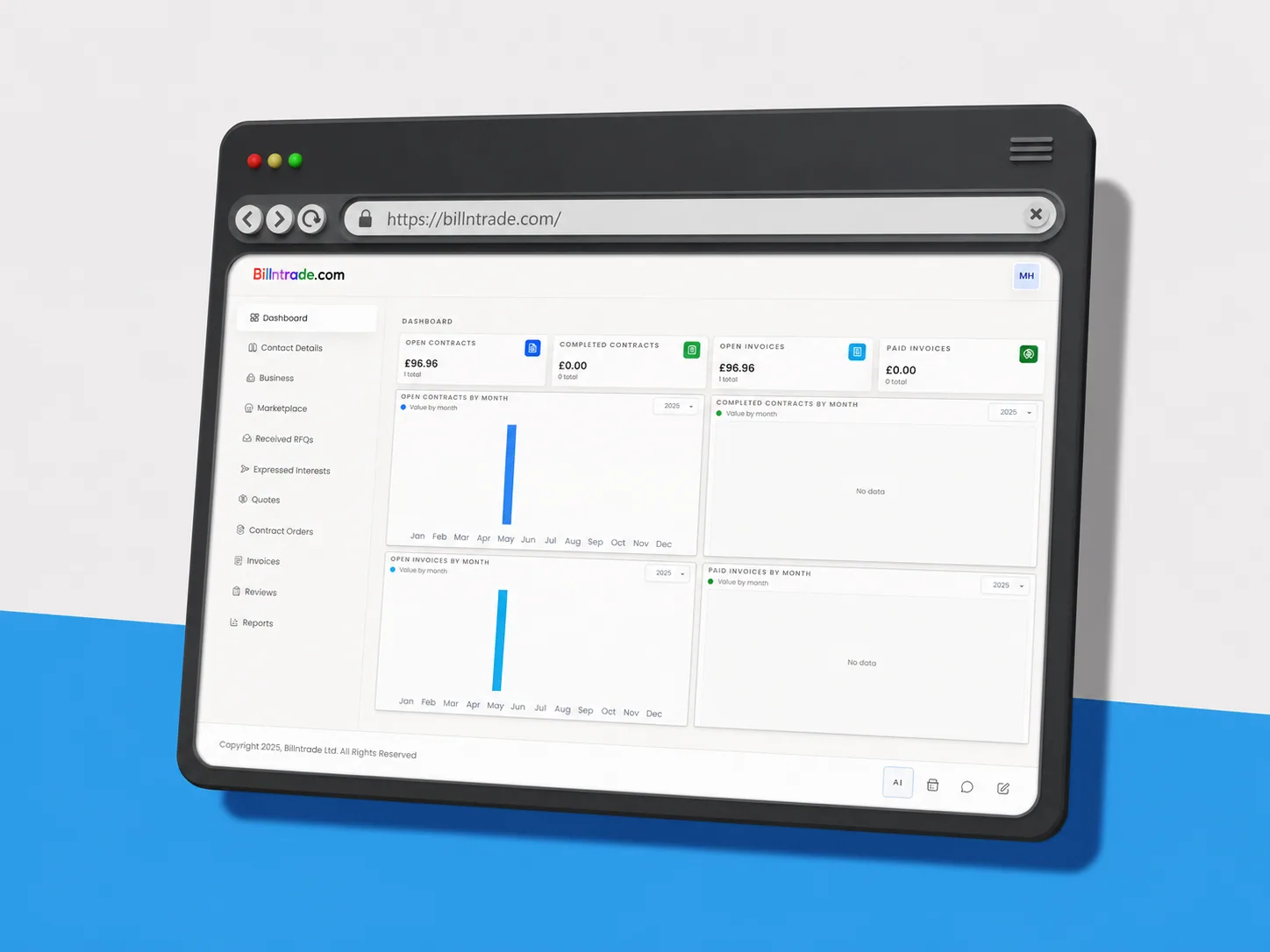
Project brief
From business need to delivered system
| Area | Project detail |
|---|---|
| Business need | A clearer SaaS story with a more polished and trustworthy product experience. |
| Product response | A frontend revamp shaped around clearer hierarchy, reusable UI, and connected API states. |
| Delivery result | A more focused product presentation that could explain the offer while remaining integration-ready. |
Business need
A clearer SaaS story with a more polished and trustworthy product experience.
Product response
A frontend revamp shaped around clearer hierarchy, reusable UI, and connected API states.
Delivery result
A more focused product presentation that could explain the offer while remaining integration-ready.
Stack used
The challenge
What Billntrade needed the build to solve
The challenge was not only visual polish. The product had to communicate its value quickly, keep technical information approachable, and respond correctly when frontend sections depended on API data. The revamp therefore had to improve hierarchy and interaction quality without disconnecting the marketing experience from the product behavior behind it.
Project facts
| Project type | Revamp |
|---|---|
| Responsibility | UI/UX, frontend, backend, database, and ecommerce workflows |
| Coverage | Public storefront and private owner dashboard |
| Technology | Next.js, React, OpenAI API, Generative AI, AI Agents, JavaScript, Tailwind CSS |
The approach
How I handled the Billntrade delivery
I started by reviewing the existing information flow and separating positioning, product detail, proof, and action so each part of the page had a clear job.
The UI/UX work then translated that structure into reusable frontend sections with stronger spacing, responsive behavior, clearer CTAs, and more consistent visual states across the experience.
Where the interface relied on live data, I connected the relevant API flows and accounted for loading, empty, success, and failure states instead of treating the page as static content only.
Alongside the product-facing work, I supported the IT operations around the live application so its connected workflows could continue serving day-to-day use.
The final structure stayed close to the product's actual needs, giving the team a cleaner base for future content, integration, and day-to-day operational updates.
System structure
The structure behind Billntrade
The delivery connected the user-facing experience with the underlying implementation, keeping the project clear to use and practical to maintain as its needs expanded.
Product narrative
Positioning, value explanation, proof, and conversion paths.
Frontend application
Reusable UI, responsive layout, interaction states, and content presentation.
API layer
Connected data flows with loading, empty, success, and error handling.
IT operations
Day-to-day support around the live SaaS application and its operational workflows.
What was delivered
The practical output of the build
| Area | Project detail |
|---|---|
| UI/UX revamp | Clearer page hierarchy, spacing rhythm, product messaging, CTA placement, and responsive interaction decisions. |
| Frontend system | Reusable React sections and maintainable responsive layouts across the product-facing experience. |
| API integration | Connected frontend states with practical handling for loading, empty, success, and error conditions. |
| IT operations | Day-to-day operational support for the live SaaS product and its connected application workflows. |
| Final polish | A more consistent, professional, and conversion-aware presentation across key screens. |
UI/UX revamp
Clearer page hierarchy, spacing rhythm, product messaging, CTA placement, and responsive interaction decisions.
Frontend system
Reusable React sections and maintainable responsive layouts across the product-facing experience.
API integration
Connected frontend states with practical handling for loading, empty, success, and error conditions.
IT operations
Day-to-day operational support for the live SaaS product and its connected application workflows.
Final polish
A more consistent, professional, and conversion-aware presentation across key screens.
Delivery coverage
The shape of the work
UI/UX
Revamp direction
Frontend
Full delivery
API
Connected flows
Responsive
Polished
Technical implementation
What had to work behind the interface
The frontend was organized around reusable sections so content and product messaging could evolve without requiring every page to be rebuilt from scratch.
API-connected areas were treated as stateful interfaces. The work accounted for what users see before data arrives, when no data exists, when a request succeeds, and when the system needs to communicate a problem.
Responsive behavior, typography, spacing, and CTA hierarchy were refined together so the revamp felt like one product experience rather than a collection of isolated page fixes.
Tools used
| Next.js | Product-facing application structure, routing, and responsive delivery. |
|---|---|
| React | Reusable UI sections, interaction patterns, and API-aware interface states. |
| JavaScript | Browser-side behavior, data presentation, and integration handling. |
| OpenAI API | AI-enabled product capabilities and connected intelligent workflows. |
| AI Agents | Agent-style product actions and intelligent workflow orchestration. |
| Tailwind CSS | Consistent responsive styling, spacing, and visual refinement. |
Outcomes
What the Billntrade delivery achieved
Billntrade received a clearer product-facing experience that made the SaaS offer easier to understand and navigate.
The interface became more dependable in the places where content or behavior depended on API responses.
The revamp created a more maintainable frontend base for future product messaging, integration work, and ongoing daily operations.
Why this matters
Clearer SaaS positioning.
Connected API-aware frontend.
Consistent responsive UI.
Stronger base for future updates.
Reference note
This case study focuses on the revamp, frontend, UI/UX, and API-connected work delivered for the product. Private service providers and internal business details are intentionally omitted.
Continue exploring
More ways to explore Billntrade.
Compare related case studies, understand the services behind this delivery, or start a conversation about your own build.
Next Step